Forced “Speedo” Labour on the Death Railway
The Narrow Road to the Deep NorthThe Speedo was the escalation of forced labour on the Death Railway that turned an already punishing construction project into a continuous demand on prisoners’ time and strength. Beginning during the monsoon of 1943, it removed rest days, raised quotas, lengthened shifts, and blurred the distinction between the sick and those close to death. Its effects reached beyond the worksite: it shaped Dorrigo Evans’s responsibilities as a prisoner commander and became a defining ordeal for Evans’ J Force.
Origins and Setting
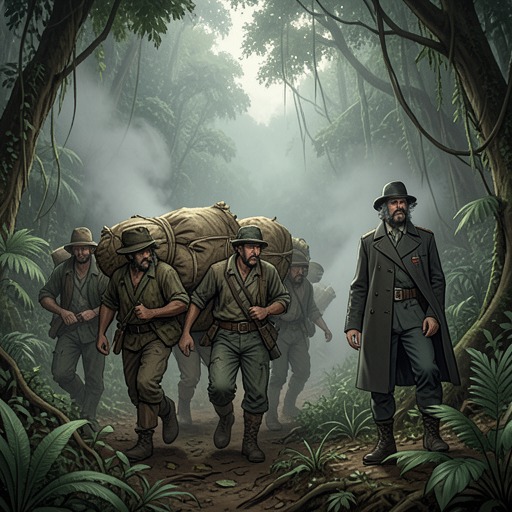
When Dorrigo Evans and the prisoners arrived in Siam in early 1943, the railway existed on the ground first as a surveyed route. Imperial Japanese Army engineers had hammered pegs into the earth to mark a line of about 415 kilometres, running from north of Bangkok through to Burma. The prisoners’ first assignment was to clear a kilometre of giant teak trees along the planned route, using blunt axes and rotten hemp rope. The railway was still a set of plans and orders, but the men were already being made to prepare its path by hand.
The project’s urgency arose from Japan’s military position. The Allies were supplying the Chinese Nationalist Army through Burma, while American control of the seas made maritime supply more difficult. Japan wanted a land route to support its forces in Burma, but lacked the machinery, money, and time to build the railway by ordinary means. Prisoners of war and other coerced labourers supplied the workforce. Of 22,000 Australian prisoners, about 9,000 were sent to work on the railway. The railway’s strategic deadline thus became a demand imposed directly on captive people and their labour.
The Acceleration of Work
Before the Speedo began, the dry-season conditions had been severe but had not yet reached the later extreme. There was some food, and the work, though hard, had not become the continuous ordeal it would be. Then the seasons turned: leaves covered the sky, food diminished, and the monsoon arrived. At first the prisoners welcomed the rain, not yet understanding what it would bring. The Speedo followed that change in conditions.
Its practical meaning was an expanding work schedule. Rest days disappeared; quotas rose repeatedly; shifts grew longer; and prisoners were increasingly ordered to work two shifts, by day and by night. The distinction between the fit and the sick, already difficult to maintain, gave way to a harsher division between the sick and the dying. The railway’s requirements did not ease as the men’s capacity declined. Instead, the regime demanded more work from a population with less food, less rest, and fewer healthy workers to share the burden.
The physical tasks remained elementary in equipment and relentless in scale. Prisoners cleared jungle, broke rock, moved earth, and carried sleepers and rails with tools such as ropes, poles, hammers, bars, baskets, and hoes. When railway plans changed, the work could expand again: a cutting already half completed was ordered enlarged by a third, requiring another 3,000 cubic metres of rock to be cut and carried away. The figures and materials make the mechanism of the Speedo plain: a construction target was translated into additional manual labour, even when equipment and manpower were inadequate.
Command and Survival
Colonel Rexroth died of dysentery during the worsening conditions, and Dorrigo Evans assumed command. His authority brought practical responsibilities as well as a public role among the prisoners. He imposed a levy on officers’ pay to buy food and drugs for the sick, and he pressed the officers to work. These actions could not halt the railway regime, but they directed scarce resources toward men in need and helped organize the prisoners’ response to it.
The prisoners called him Colonel to his face and the Big Fella elsewhere. Dorrigo felt the distance between his actual self and the self the men seemed to need: the Big Fella was imagined as more self-sacrificing and noble than Dorrigo believed himself to be. Their growing respect reinforced that role, making leadership something the group helped impose on him even as he tried to lead them. Under the Speedo, command therefore meant more than giving orders. Dorrigo was expected to carry the hopes and needs of men whose circumstances left them with little control over their own work or survival.
Small acts and shared habits persisted alongside that pressure. An occasional duck egg, a little palm sugar, a repeated joke, and the prisoners’ asides and curses mattered in a setting where food and rest had become their central concerns. Such moments did not reverse the conditions, but they formed part of how the men endured them together. Evans’ J Force remained a group in the prisoners’ understanding even as deaths reduced their number; their attachment to one another became more pronounced as comrades died.
Death, Memory, and the Railway’s Afterlife
The dead accumulated as the work continued. The camp hospital hut filled with men who were severely ill, while the prisoners’ attention narrowed increasingly to food and rest. The Speedo’s consequence was not simply exhaustion at the end of a shift: it organized days and nights around labour and left fewer opportunities to recover. Dorrigo later recalled that the men had worked for seventy days and nights through the monsoon without a day off. He also remembered the day Darky Gardiner was beaten as the day Guy Hendricks was cremated. He said the scene had sounded terrible and noble when he tried to write it, but that it had been miserable and stupid. The recollection resists turning the suffering into an uplifting story of endurance.
The railway was completed, and on 25 October 1943 locomotive C 5631 travelled its length. The achievement was set against the human cost: one in three of the Australian prisoners sent to work on the railway would die, and the Australian dead were only a fraction of the total labourers who died. Estimates for Asian labourers’ deaths vary widely, and the total is unknown. The Speedo belongs to that larger history of a project whose deadlines and construction targets were made possible through captive labour, while its workers’ losses were not recorded with equal certainty.
After the war, the railway lost its military purpose and support. It was abandoned, dismantled, and gradually reclaimed by vegetation; some sections were later cleared as tourist, sacred, or national sites. The contrast between construction and decay gives the Speedo its wider significance. The intense demand for labour served a railway that did not endure as an imperial achievement, while the people who paid for its construction could not all be named or counted. Dorrigo’s remembered days of unbroken work connect the railway’s physical history to the less visible history of those forced to build it.